Loading...
Mon-Fri (9:30AM to 7:00PM) & Sat,Sun (9:30AM to 6:30PM)
info@iva-institute.com | Dubai : +97 15574 19282 Login/Register
Intermediate Bangla

Cisco Certified Network Associate

0.0 (0 reviews)
1,245 students enrolled

Take your IT career in any direction by earning a CCNA. CCNA validates a broad range of fundamentals for all IT careers - from networking technologies, to security, to software...
Classes 20
Duration 40 hrs
Quizzes 15
Language Bangla
Training Image

AED 999.00

AED 12,000.00
Enroll Now
Start Date: Anytime
Certificate: Included
Access: Lifetime

About This Training

Take your IT career in any direction by earning a CCNA. CCNA validates a broad range of fundamentals for all IT careers - from networking technologies, to security, to software development - proving you have the skills businesses need to meet market demands.

Key Selling Points (The "What You Get")

Use concise bullet points or bold text to highlight the main benefits.

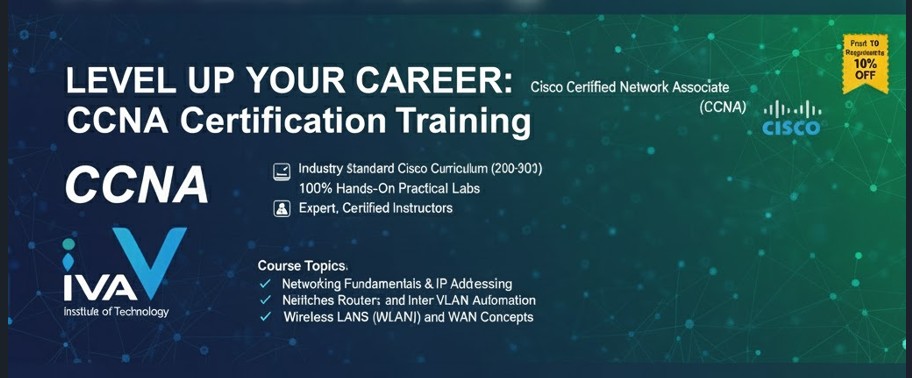
Industry-Standard Cisco Curriculum (200-301)

💻 100% Hands-On Practical Labs (using real/simulated Cisco gear)

👨‍🏫 Expert, Certified Instructors

🚀 Pathway to a High-Paying Networking Career

⏱️ Flexible Batch Timings / Weekend Classes Available

Learning Journey

1.1 Explain the role and function of network components 1.1.a Routers 1.1.b Layer 2 and Layer 3 switches 1.1.c Next-generation firewalls and IPS 1.1.d Access points 1.1.e Controllers (Cisco DNA Center and WLC) 1.1.f Endpoints 1.1.g Servers 1.1.h PoE 1.2 Describe characteristics of network topology architectures 1.2.a Two-tier 1.2.b Three-tier 1.2.c Spine-leaf 1.2.d WAN 1.2.e Small office/home office (SOHO) 1.2.f On-premise and cloud 1.3 Compare physical interface and cabling types 1.3.a Single-mode fiber, multimode fiber, copper 1.3.b Connections (Ethernet shared media and point-to-point) 1.4 Identify interface and cable issues (collisions, errors, mismatch duplex, and/or speed) 1.5 Compare TCP to UDP 1.6 Configure and verify IPv4 addressing and subnetting 1.7 Describe private IPv4 addressing 1.8 Configure and verify IPv6 addressing and prefix 1.9 Describe IPv6 address types 1.9.a Unicast (global, unique local, and link local) 1.9.b Anycast 1.9.c Multicast 1.9.d Modified EUI 64 1.10 Verify IP parameters for Client OS (Windows, Mac OS, Linux) 1.11 Describe wireless principles 1.11.a Nonoverlapping Wi-Fi channels 1.11.b SSID 1.11.c RF 1.11.d Encryption 1.12 Explain virtualization fundamentals (server virtualization, containers, and VRFs) 1.13 Describe switching concepts 1.13.a MAC learning and aging 1.13.b Frame switching 1.13.c Frame flooding 1.13.d MAC address table

2.1 Configure and verify VLANs (normal range) spanning multiple switches 2.1.a Access ports (data and voice) 2.1.b Default VLAN 2.1.c InterVLAN connectivity 2.2 Configure and verify interswitch connectivity 2.2.a Trunk ports 2.2.b 802.1Q 2.2.c Native VLAN 2.3 Configure and verify Layer 2 discovery protocols (Cisco Discovery Protocol and LLDP) 2.4 Configure and verify (Layer 2/Layer 3) EtherChannel (LACP) 2.5 Interpret basic operations of Rapid PVST+ Spanning Tree Protocol 2.5.a Root port, root bridge (primary/secondary), and other port names 2.5.b Port states (forwarding/blocking) 2.5.c PortFast 2.5.d Root guard, loop guard, BPDU filter, and BPDU guard 2.6 Describe Cisco Wireless Architectures and AP modes 2.7 Describe physical infrastructure connections of WLAN components (AP, WLC, access/trunk ports, and LAG) 2.8 Describe network device management access (Telnet, SSH, HTTP, HTTPS, console, TACACS+/RADIUS, and cloud managed) 2.9 Interpret the wireless LAN GUI configuration for client connectivity, such as WLAN creation, security settings, QoS profiles, and advanced settings

3.1 Interpret the components of routing table 3.1.a Routing protocol code 3.1.b Prefix 3.1.c Network mask 3.1.d Next hop 3.1.e Administrative distance 3.1.f Metric 3.1.g Gateway of last resort 3.2 Determine how a router makes a forwarding decision by default 3.2.a Longest prefix match 3.2.b Administrative distance 3.2.c Routing protocol metric 3.3 Configure and verify IPv4 and IPv6 static routing 3.3.a Default route 3.3.b Network route 3.3.c Host route 3.3.d Floating static 3.4 Configure and verify single area OSPFv2 3.4.a Neighbor adjacencies 3.4.b Point-to-point 3.4.c Broadcast (DR/BDR selection) 3.4.d Router ID 3.5 Describe the purpose, functions, and concepts of first hop redundancy protocols

4.1 Configure and verify inside source NAT using static and pools 4.2 Configure and verify NTP operating in a client and server mode 4.3 Explain the role of DHCP and DNS within the network 4.4 Explain the function of SNMP in network operations 4.5 Describe the use of syslog features including facilities and levels 4.6 Configure and verify DHCP client and relay 4.7 Explain the forwarding per-hop behavior (PHB) for QoS, such as classification, marking, queuing, congestion, policing, and shaping 4.8 Configure network devices for remote access using SSH 4.9 Describe the capabilities and functions of TFTP/FTP in the network

5.1 Define key security concepts (threats, vulnerabilities, exploits, and mitigation techniques) 5.2 Describe security program elements (user awareness, training, and physical access control) 5.3 Configure and verify device access control using local passwords 5.4 Describe security password policies elements, such as management, complexity, and password alternatives (multifactor authentication, certificates, and biometrics) 5.5. Describe IPsec remote access and site-to-site VPNs 5.6 Configure and verify access control lists 5.7 Configure and verify Layer 2 security features (DHCP snooping, dynamic ARP inspection, and port security) 5.8 Compare authentication, authorization, and accounting concepts 5.9 Describe wireless security protocols (WPA, WPA2, and WPA3) 5.10 Configure and verify WLAN within the GUI using WPA2 PSK

6.1 Explain how automation impacts network management 6.2 Compare traditional networks with controller-based networking 6.3 Describe controller-based, software defined architecture (overlay, underlay, and fabric) 6.3.a Separation of control plane and data plane 6.3.b Northbound and Southbound APIs 6.4 Explain AI (generative and predictive) and machine learning in network operations 6.5 Describe characteristics of REST-based APIs (authentication types, CRUD, HTTP verbs, and data encoding) 6.6 Recognize the capabilities of configuration management mechanisms, such as Ansible and Terraform 6.7 Recognize components of JSON-encoded data

No Reviews Yet

Be the first to review this training

Download Full Course Details

Get a complete PDF copy of this course with company information and watermark.

Download PDF

Your Guide
Instructor
Ashish Halder

Master Trainer

With over 8 years of experience in this field, our instructor makes learning engaging and effective for all students.

Perfect For
N/A
What You'll Learn
  • Practical skills you can use immediately
  • Hands-on projects and exercises
  • Industry best practices
  • Confidence in your new skills

What Students Say

No Reviews Yet

Be the first to share your experience!